
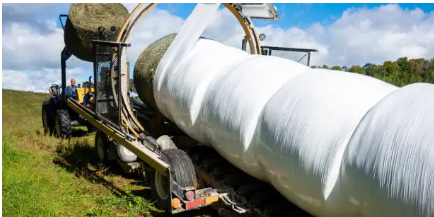
A bale can leave the paddock looking perfect and still be quietly losing its value before livestock ever eat it. In Australia, where farmers regularly contend with heat, dust, unpredictable rainfall and demanding harvest windows, the few seconds spent deciding how and when to wrap a bale can have consequences that last for months. Bale wrap is not simply the final layer around freshly baled forage—it is a critical part of the preservation process that protects valuable feed from oxygen, moisture, and environmental damage.
The surprising part? A decision made in roughly 30 seconds can influence whether that feed remains a reliable nutritional resource or becomes an expensive source of waste.
The Clock Starts Running the Moment the Bale Is Made
Once forage is baled, the preservation process becomes a race against time. The goal is to create an environment that limits undesirable biological activity and lets you store the forage with minimal deterioration.
That means wrapping isn’t just another task to complete at the end of a busy day.
● Timing matters: Delays between baling and wrapping can increase exposure to air and weather, particularly when conditions are hot or humid.
● Moisture matters: Forage baled with unsuitable moisture levels may be more vulnerable to preservation problems, mould or undesirable fermentation.
● The weather window matters: Australian farmers may need to make rapid decisions when a narrow period of suitable weather appears between rainfall events.
Imagine a contractor or farm operator watching clouds build on the horizon. They may feel pressure to bale as much forage as possible before conditions change. But rushing the wrapping decision without considering moisture, handling and application can create problems that are impossible to reverse later.
Once the bale is stored, the opportunity to correct a poor preservation decision shrinks.
What Happens When the Wrap Looks Fine—but Isn’t Doing Its Job?
One of the most deceptive aspects of wrapped forage is that appearance alone does not always tell the full story. A bale can look neatly covered while still having weaknesses that affect its long-term protection.
Bale wrap effectiveness depends on more than simply covering the entire surface.
● Stretch and tension: If the film is not applied correctly, the resulting seal may not provide the intended level of protection.
● Overlap: Inadequate overlap between layers can create vulnerable areas where oxygen or moisture can enter the bale.
● Physical damage: Punctures and tears caused by machinery, sharp surfaces, animals or wildlife can compromise the barrier.
This is particularly relevant for Australian producers who may move bales between paddocks, storage areas and feeding locations. Every additional handling event introduces another opportunity for damage.
The lesson is straightforward: view the wrapping process as part of the bale’s preservation system—not merely a visual finishing step.
The Six-Month Test: Can Your Feed Survive Storage?
The real test of a wrapping decision does not happen on the day the bale is made. It happens weeks or months later, when the bale is opened, and the producer discovers whether the forage has retained its expected quality.
For Australian livestock operations, that storage period can bridge critical seasonal gaps.
● Protecting feed reserves: Well-preserved forage can provide an important buffer when pasture growth slows, or seasonal conditions deteriorate.
● Reducing avoidable waste: Damage during storage can turn usable feed into spoilage, increasing the amount of material that must be discarded.
● Protecting the farm budget: Every kilogram of feed lost may eventually need to be replaced with purchased hay, grain or other supplements.
This is where the economics become interesting. Farmers often focus on the upfront cost of wrapping materials, but the more important figure may be the cost per kilogram of usable feed successfully preserved.
A cheaper approach that leads to more spoilage may ultimately cost more than investing in a reliable preservation process.
Turning 30 Seconds Into a Better Preservation Strategy
The good news is that improving bale preservation does not necessarily require a complicated system. Often, it begins by slowing down long enough to make better decisions at critical points.
Before wrapping, Australian farmers and contractors can ask a few practical questions:
● Is the bale ready to be wrapped? Consider moisture and forage conditions rather than treating every bale identically.
● Is the equipment applying the film correctly? Regularly check the wrapper, film tension, application settings and overlap.
● Will the bale be protected after wrapping? Plan how it will be transported, stacked and stored to minimise the risk of punctures and unnecessary handling.
It is also worth inspecting wrapped bales periodically rather than assuming they will remain intact indefinitely. A damaged bale identified early may be easier to manage than one discovered months later after significant deterioration has occurred.
The objective is not to slow down the process. It is to make those critical 30 seconds more deliberate.
The Decision You Make Today Determines What You Feed Tomorrow
The biggest misconception about bale wrap may be that its job ends once the bale is covered. In reality, that is when its most important job begins.
For Australian farmers, every bale represents more than harvested grass or forage. It represents land, fertiliser, fuel, machinery, labour and time—all invested with the expectation that the feed will remain valuable when livestock eventually need it.
A rushed wrapping decision can undermine that investment. A thoughtful one can help preserve it.
Your next step should be simple: review your current wrapping process from baling through storage, and identify the point where feed quality is most vulnerable. It could be moisture management, wrapping speed, film application, bale handling or storage conditions.
Fix that weak point first.
Because the difference between a bale that merely looks wrapped and one that successfully preserves months of feed quality may come down to a decision that takes less than 30 seconds.